

Most eCommerce businesses don’t realize they’ve outgrown their ERP all at once. The system still works. Orders still go out. Reports still run. What changes is the effort it takes to keep everything moving.
As volume increases and operations become more involved, the eCommerce ERP system that once felt sufficient starts requiring more manual oversight, more workarounds, and more time just to maintain stability. That’s often the first sign the system is no longer keeping pace.
For many teams, recognizing that moment is the first step toward building a more scalable eCommerce operation.
How eCommerce Growth Changes System Requirements
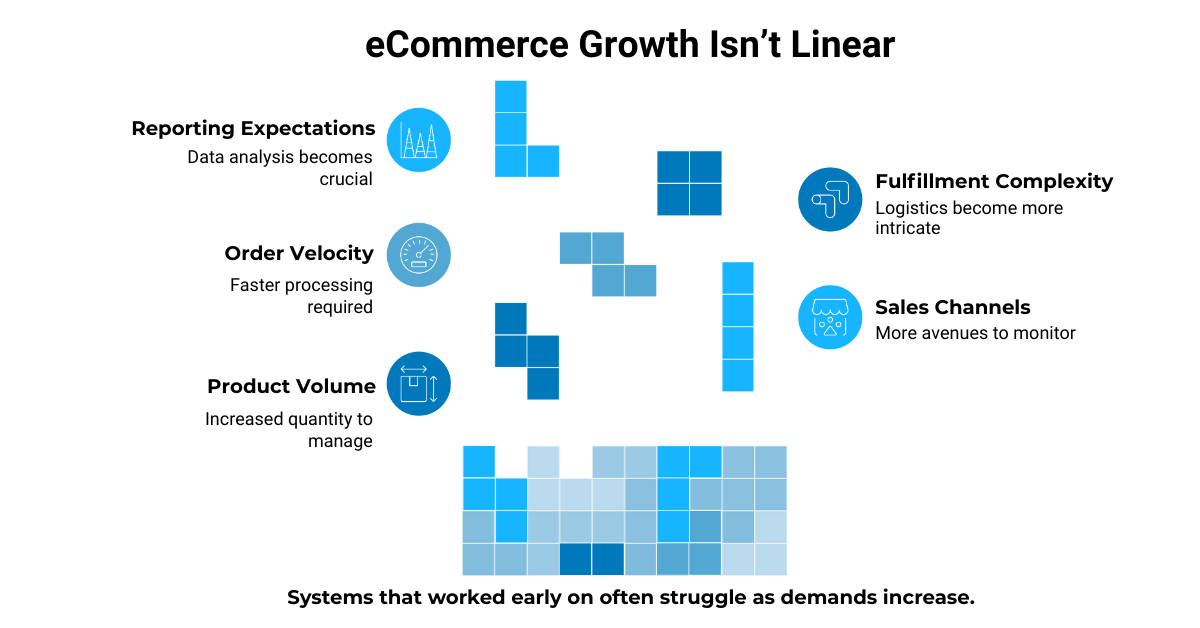
Early-stage eCommerce operations are fairly simple. Most companies start with a limited number of products, one or two sales channels, and straightforward fulfillment. As the business grows, that simplicity disappears.
Growth introduces:
-
More SKUs and product variants
-
Multiple sales channels and marketplaces
-
Higher order volumes and faster fulfillment expectations
-
More complex inventory and returns management
-
Increased pressure on margins and reporting accuracy
An eCommerce ERP system that worked well at lower volume may still function, but it often struggles to handle these added demands. Teams begin adjusting their workflows to accommodate system limitations rather than relying on the system to support growth.
1. Manual Work Becomes a Core Part of Operations
One of the most common signs a business has outgrown its ERP is the amount of manual work required to keep things running. Spreadsheets become part of daily operations. Data is exported, corrected, and re-entered. Teams build workarounds to handle tasks the system can’t manage on its own.
This often includes:
-
Manually updating inventory between systems
-
Re-entering order data for accounting or fulfillment
-
Tracking exceptions outside the ERP
-
Relying on a few individuals who understand unofficial processes
These workarounds appear because the ERP for eCommerce can’t keep pace with how the business operates today. Over time, manual processes slow execution, increase the risk of errors, and pull teams away from higher-value work.
2. Data Lives in Multiple Systems With No Single Source of Truth
As eCommerce operations grow, it’s common for data to spread across platforms, your eCommerce site, ERP, warehouse tools, accounting software, and reporting systems.
When those systems aren’t well connected, problems surface quickly:
-
Inventory levels don’t match across platforms
-
Sales and finance reports tell different stories
-
Leaders hesitate to trust dashboards or forecasts
Without strong ERP eCommerce integration, teams spend more time reconciling numbers than using them.
3. Inventory, Order, and Fulfillment Issues Increase With Volume
Inventory challenges tend to intensify as order volume grows. Stock-outs occur even when inventory appears available. Backorders increase unexpectedly. Orders get delayed or routed incorrectly as fulfillment logic becomes more complex.
These issues are rarely caused by a lack of effort. They’re often the result of systems that can’t provide real-time visibility or manage modern fulfillment workflows at scale.
The impact goes beyond operations:
-
Missed revenue
-
Higher return rates
-
Customer frustration
-
Increased support tickets
At a certain point, the eCommerce ERP system becomes a bottleneck instead of a backbone.
4. Reporting Is Slow, Inflexible, or Hard to Trust
Reporting challenges are another major indicator that an eCommerce ERP system is being stretched too far.
Leaders may notice:
-
Reports that take days to produce
-
Limited visibility into margins, fulfillment costs, or channel performance
-
Difficulty answering simple questions without manual analysis
When reporting lags behind the business, teams are forced to react instead of plan. Growth becomes harder to manage because insight arrives too late.
5. Teams Spend More Time Fixing Issues Than Planning for Growth
Perhaps the most telling sign of all is how teams spend their time. When operations teams are constantly troubleshooting, finance teams are manually closing the books, and leadership is pulled into daily system issues, something is off.
An ERP for eCommerce should reduce these issues as the business scales. Not require more effort just to keep everything on track.
Why ERP eCommerce Integration Becomes Critical
A solid ERP for eCommerce should quietly handle the basics so teams can focus on running the business, keeping inventory accurate across channels, moving orders through fulfillment without constant intervention, and making it easy to see how the business is actually performing.
For leadership, now’s the time to step back and take stock:
-
Are manual processes increasing instead of fading away?
-
Do teams trust the data they see every day?
-
Can inventory and fulfillment keep up without constant fixes?
-
Is the system helping the business scale, or getting in the way?
If those questions are becoming harder to answer, it’s often a sign the current setup has reached its limits.
How Cloud 9 ERP Solutions Can Help
At Cloud 9 ERP Solutions, we work with eCommerce businesses that have reached this exact point.
As a Gold Certified Acumatica Partner, Cloud 9 helps eCommerce teams assess whether their current systems can support continued growth and, when needed, implement solutions that make operations easier to manage as complexity increases. Want to learn more about Acumatica ERP’s eCommerce software? Schedule a consultation with us today.